Perfect Love Through Infant Eyes
God so Loved the World that God Gave
How is it that a loving God would create me with feelings I never asked for, then tell me those same feelings are sinful? Then deny me God’s love and damn me to an eternity in hell unless I change them? I have tried to reconcile those questions for years. But I can’t. I cannot reconcile myself to believe God is in the business of making a joke out of something He painstakingly created with such reverence.
If that is the definition of a loving God, then that is not a God I want in my life.
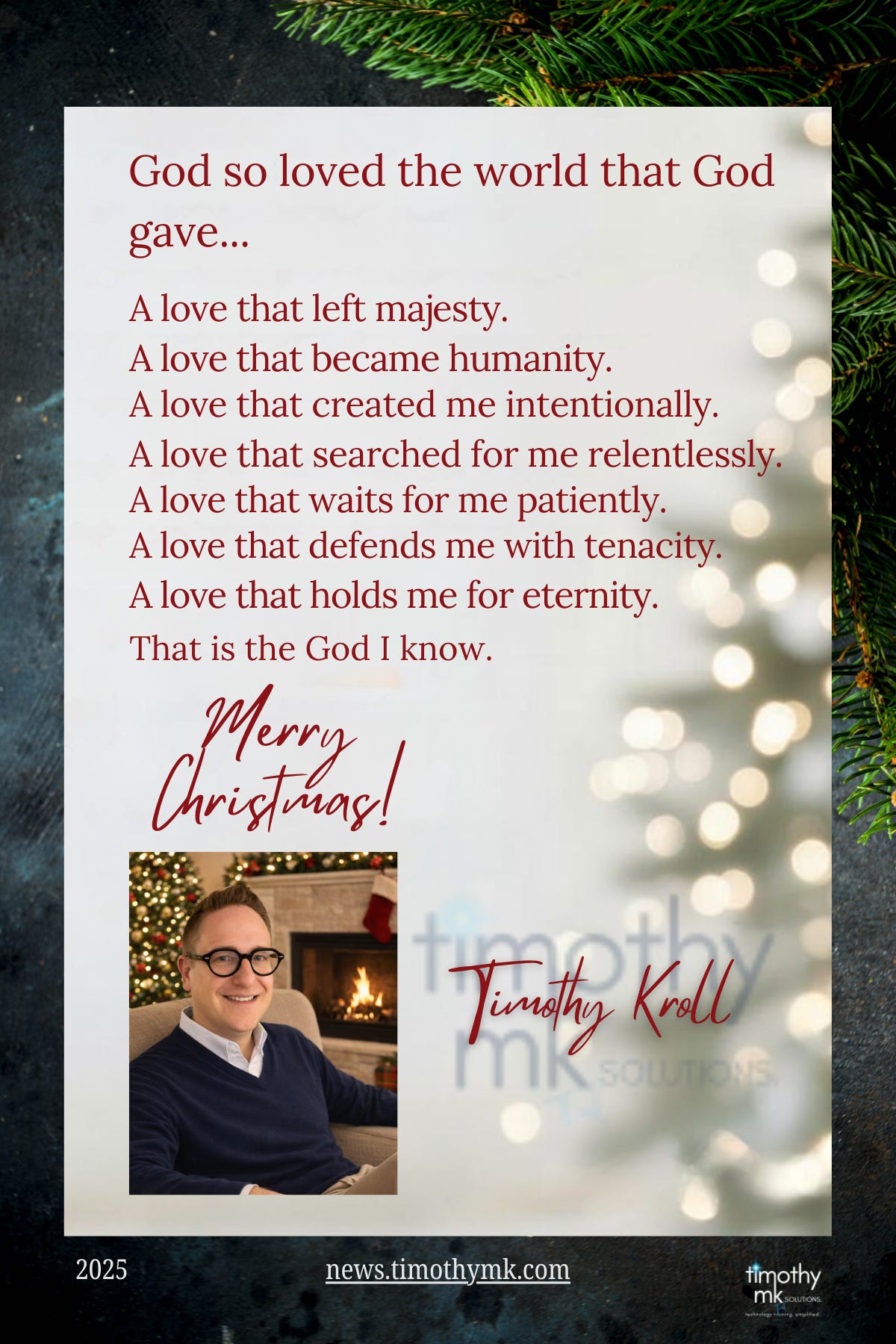
I keep coming back to the same sentence which is the theme of my 2025 Christmas card:
“God so loved the world that God gave…”
I’ve heard it a thousand times.
I’ve quoted it.
I’ve watched people weaponize it.
I’ve watched others soften it into something polite and distant—like it’s only meant for stained glass and Christmas carols.
But this year, I wrote it the way I actually live it now: as a beginning, not a slogan.
Because for a long time, I believed
God gave… conditions.
God gave… tests.
God gave… a version of me I was supposed to become.
And if I’m honest, I wasn’t just confused—I was exhausted. I spent years trying to earn what was supposedly “free.” I kept reaching for a love that always seemed to stay one step ahead of me, like a horizon I could never touch.
So the card I made isn’t just a Christmas message. It’s a confession. It’s me admitting—out loud—that the God I know now is not the God I was taught to fear.
The love that left majesty
Christmas has always been framed as a nice story: cozy manger, sweet baby, warm lights. But the older I get, the more offensive Christmas becomes—in the best way.
Because if God “left majesty,” then God is not interested in maintaining distance.
That matters to me, because I spent years in a faith environment where distance was practically holy. God was up there, we were down here, and the job of church was to manage the gap with rules, performance, and fear.
But Christmas tells a different truth: God didn’t send a memo. God didn’t outsource love. God showed up.
And if God is the kind of God who leaves majesty for messy humanity, then I can stop pretending I have to climb my way into worthiness. The direction of the gospel isn’t me reaching up. It’s God coming down.
That changes everything.
The love that became humanity
I used to think “God with us” was poetic. Now I think it’s practical.
Because my life hasn’t been theoretical.
My story includes religious certainty that turned into religious confusion. It includes leadership roles I was proud of that later became part of my grief. It includes trying to “fix” what wasn’t broken. It includes a marriage that ended when I finally told the truth out loud. It includes losing my mom in 2017—one of the deepest pains of my life—while still knowing, in my bones, that she loved me fiercely even when she didn’t understand me.
And it includes seasons where I didn’t just feel far from God—I felt done.
So when I say “a love that became humanity,” I’m not admiring an idea. I’m clinging to a reality: God isn’t repulsed by real life. God stepped directly into it.
Which means I don’t have to sanitize my story to be loved.
I don’t have to hide my questions to belong.
I don’t have to pretend I’m okay to be held.
The love that created me intentionally
This line is the one that would’ve gotten me in trouble in my old world.
Because I was taught to speak about myself like an unfortunate glitch—something God tolerated while expecting me to override my “temptations” with enough discipline and prayer. I learned how to be the kind of Christian who looked “whole” while quietly bleeding out inside.
And if I’m going to be painfully honest: I helped others do the same.
I led a gay conversion group using Desert Streams / Living Waters material. I believed I was helping. I believed I was offering hope. I believed holiness required people to become someone else.
Now I can say it plainly: that framework did harm.
Not because anyone set out to be cruel, but because the foundation was wrong. It treated people’s core selves as problems to solve instead of people to love.
So “created me intentionally” isn’t a cute affirmation for me. It’s a line I had to fight for. It’s the sentence that dragged me out of the bargain I didn’t realize I was making with God:
“If I can just become the version of me the church approves of… then maybe God will finally relax and love me.”
This year, I’m not bargaining.
I’m not negotiating my right to exist.
I’m not calling my design a defect.
I’m saying—with clarity I didn’t have before—God created me intentionally. And if that is true, then my life is not an apology.
The love that searched for me relentlessly
There was a stretch where I walked away from church altogether. I wasn’t trying to be rebellious. I was trying to breathe.
When you spend years in a system that calls your very self “broken,” eventually you either disappear inside yourself or you leave.
I left.
And then life piled on. Grief. Isolation. Financial collapse. The slow erosion of confidence. And eventually, alcohol—night after night—until the bar started to feel more like a home than faith ever did.
That’s not a proud paragraph to write. But it’s an honest one.
And here’s what I know now: God didn’t wait for me to clean that up.
God searched. Not like a detective hunting evidence. Like a shepherd who refuses to lose someone beloved. Like a love that doesn’t get distracted by shame.
I used to think “relentless” meant pressure—God chasing me to correct me.
Now I know relentless means God chasing me to keep me.
The love that waits for me patiently
Patience is a word we toss around, but I didn’t understand it until I realized God wasn’t in a hurry to punish me.
I’ve had to rebuild faith from the ground up. Not just belief in God, but trust. And trust doesn’t return because someone tells you to “have more faith.” Trust returns when love proves itself safe.
For me, that safety started showing up again through Park Church—the first place in a long time where I didn’t feel like I had to split myself into “acceptable” and “unacceptable” parts to be near God.
Patience looks like that: space to heal. Space to untangle. Space to admit, “I don’t know what I believe yet,” without being treated like a threat.
If you’ve ever had to unlearn a harmful theology, you know how slow it is. It’s not a switch. It’s rehab.
And I’m grateful that the God I’m getting to know isn’t tapping a foot, arms crossed, waiting for me to catch up. God is steady. God is kind. God is patient.
The love that defends me with tenacity
This is where my opinions get loud.
I don’t believe God defends me by making me tougher. I believe God defends me by refusing to let lies have the final word over my life.
And I have swallowed a lot of lies.
That my orientation disqualified me from love.
That my honesty would ruin everything.
That God’s “best” required me to disappear.
That the only faithful future was the one built on self-erasure.
Tenacity is God standing between me and the stories that tried to shrink me.
Tenacity is God insisting that I am not a cautionary tale—I’m a beloved son.
Tenacity is God defending the parts of me religion tried to condemn.
And sometimes, God’s defense looks like this: a slow, stubborn rebuilding of dignity when you’ve spent years praying for the wrong miracle.
The love that holds me for eternity
I used to imagine eternity as a reward for people who got everything right.
Now I think eternity is the natural extension of a love that refuses to quit.
Because if God’s love can hold me through collapse, grief, addiction, lost work, and the aching process of becoming honest—then eternity isn’t a finish line I have to sprint to.
It’s a promise that love doesn’t run out.
And on the days I’m still scared—still healing—still learning how to live without bargaining—this is what steadies me:
I am held.
Not lightly. Not temporarily. Not conditionally.
Held.
That is the God I know.
That last line is the quietest one on the card, and it might be the loudest one in my life.
Because it’s not abstract anymore.
The God I know isn’t the God of spiritual performance reviews.
The God I know isn’t dangling belonging like a prize.
The God I know doesn’t create people intentionally and then demand they apologize for being created.
The God I know is love that gave—and keeps giving—without asking me to disappear first.
It’s a perfect love that came into an imperfect world as a pure, innocent baby. When I look into the eyes of that baby I see the purest love. A love not tainted by the opinions of humanity. A simple, pure and innocent love — full of grace and acceptance.
So yes, I’ll say it like I mean it:
Merry Christmas.
Not because everything is perfect.
But because love came close.
And when love comes close, even the wreckage becomes holy ground.
And this year, for the first time in a long time, I’m not just talking about God.
I’m talking about the God I know.


