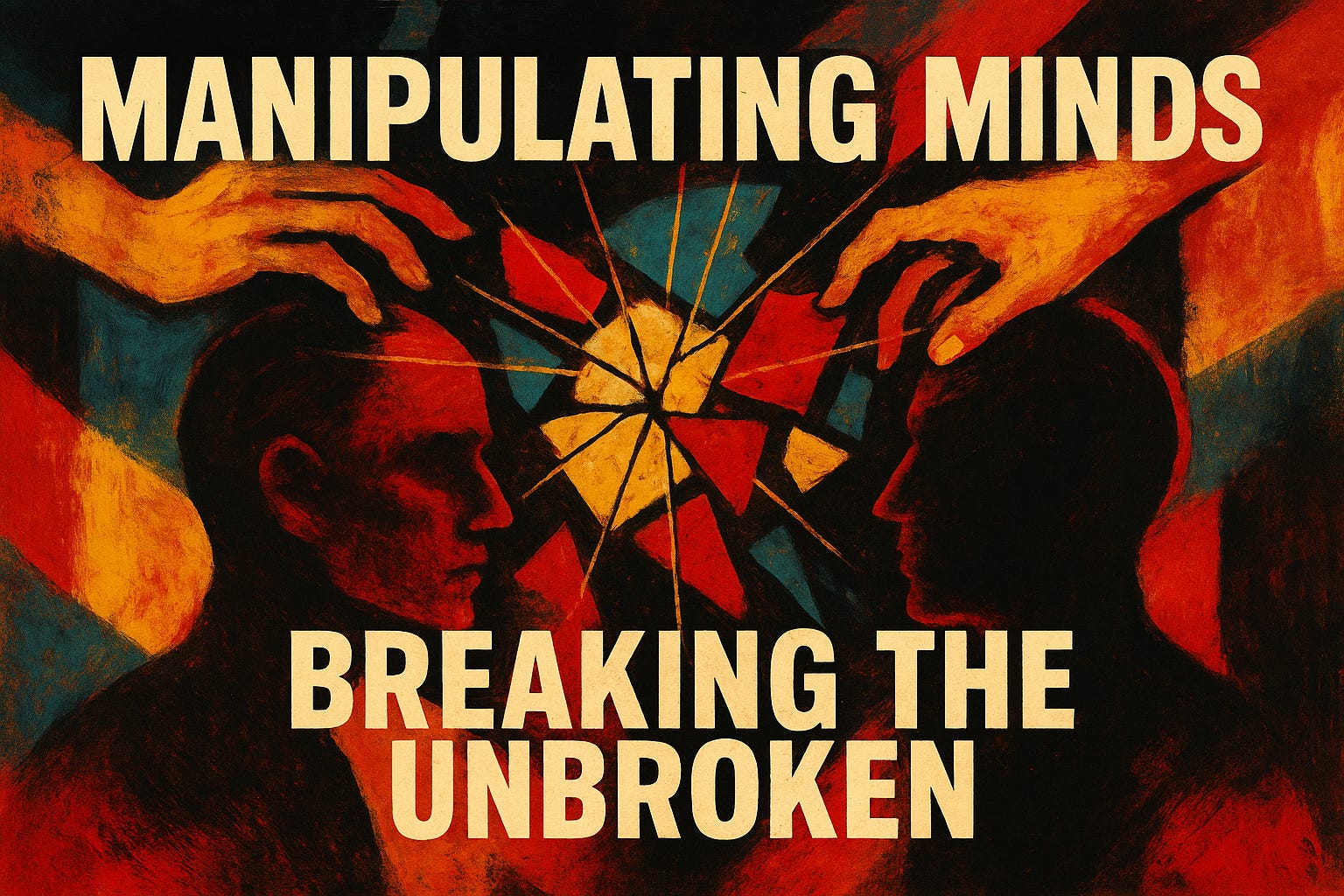
Manipulating Minds - Breaking the Unbroken
How Faith Based Programs Ensure Everyone is Broken
I didn’t realize a church could rewrite the story of my life with whispers and good intentions. But there I was, sitting in a dimly lit room, learning to doubt the very memories that once made me feel whole. What they called healing felt more like erosion — a slow wearing away of truth, identity, and the sacred simplicity of a childhood built on love. Some harms don’t roar; they glide in quietly, dressed as prayer, and you don’t recognize the damage until the person staring back at you in the mirror feels like a stranger.
“If the ‘healing’ requires me to disappear, it’s not healing. It’s harm.”
A Childhood Built on Love and Faith
I grew up in a home many people would envy. Stability wasn’t a luxury in our house; it was the air we breathed. My parents loved their kids fiercely, raised us with conviction, and practiced their faith with sincerity.
I didn’t grow up around conflict. I never once witnessed a fight between my mom and dad, I have never even heard them swear. Our home wasn’t a battleground; it was a sanctuary full of love and laughter.
No abuse.
No neglect.
No emotional absence.
No spiritual abandonment.
Just a loving Christian family doing the best they could with the interpretation of Scripture they believed to be true.
And yet—even with all that love—I knew from my earliest memories that my sexuality wouldn’t be something they could accept. That tension sat quietly beneath the surface of my childhood, but it never erased the love we felt at home.
Which is why what happened later cut so deeply.
How Living Waters and Falling Forward Rewrote My Story
In the early 2000s, my home church introduced me to two programs from the Desert Streams ministry—programs I would come to trust far more than I should have.
Living Waters was the first program I encountered—a discipleship-style “healing” ministry for both men and women dealing with anything the church labeled as “sexual brokenness.” It cast a wide net: trauma, addiction, unwanted attractions, intimacy issues, codependency. It promised restoration, wholeness, identity.
But Falling Forward was different. It was laser-focused on gay men. Men like me.
The premise was simple, unshakeable, and—looking back—deeply misguided:
If you are gay, something painful happened that made you this way.
Your task is to find the wound.
If you didn’t know what it was? You were taught to keep digging.
Under the gentle pressure of testimonies, prayer sessions, teachings, and weekly small groups, the message slowly took root.
Your childhood is not what you think it was.
Your story is unreliable.
Your memories cannot be trusted.
Suddenly, decades of love, stability, and warmth became “evidence” of something hidden and broken.
I had a deeply loving father.
But the program suggested he had been emotionally absent.I had a secure childhood.
But the program implied I had repressed trauma.
I walked in seeking wholeness. I found a narrative that demanded my past be rewritten.
“I didn’t walk into the program broken, yet the program demanded I was.”
Leadership Matters
To understand these programs, you have to understand the man behind them. Andrew Comiskey, the founder of Desert Stream Ministries, didn’t just write the curriculum — he shaped the entire worldview it was built on. His personal story became the template for ours, and his conclusions about sexuality became the lens through which thousands of us were told to reinterpret our lives.
What I didn’t realize then is that Desert Stream wasn’t just a ministry; it was an extension of one man’s testimony elevated to a universal truth. And even today, the organization continues to operate under that same framework, offering Living Waters as a path to “healing,” despite its history of controversy — including the firing and later imprisonment of a former staff member for child sexual abuse in the late ’90s.
None of that seemed to slow the ministry down. Churches kept adopting the material because it offered them something familiar, something that protected their theology, something that made LGBTQ lives easier to categorize. In that kind of environment, a program doesn’t need to be healthy to survive — it only needs to affirm what people are already afraid to question.
That’s why naming the leadership matters. Because when a whole ministry is built on a single story, the cracks in that story eventually become cracks in the people who follow it.
Manipulation Hidden Inside “Listening Prayer”
One of the most damaging rituals embedded in both the Living Waters and Falling Forward programs was something we called listening prayer. On the surface, it appeared gentle and spiritual—an intimate moment where the Holy Spirit was invited to speak into someone’s deepest wounds. But in practice, it became a powerful tool of suggestion, shaping memories and rewriting personal histories in ways that still make me uneasy when I look back.
Listening prayer sessions usually took place in small groups. The leader would place their hands on a participant’s shoulders or back, begin praying quietly in tongues, and encourage them to “be open to suppressed memories.” The expectation was clear: if you were gay, there was a hidden wound somewhere in your past. And if you couldn’t remember one, it was simply because you weren’t listening hard enough.
In that environment—emotionally charged, spiritually intense, and guided by people who believed they were speaking on behalf of God—imagination quickly blurred into memory. Vulnerability became a doorway to suggestion. And suggestion became the seed of a story that never existed.
There were moments, as a leader, when I found myself nudging participants toward an answer—suggesting possibilities they hadn’t considered, hinting at childhood abuse that never happened, or proposing that perhaps their father wasn’t as loving or present as they remembered. It wasn’t malicious; it was simply what the system trained us to do. But looking back, I can see how easily those “gentle prompts” became catalysts for people to question the very foundations of their own stories.
In that setting, the mind becomes pliable. A raised eyebrow, a leading question, a softly spoken “Is it possible…?” can send someone down a path they were never meant to walk. And slowly, the participants begin to adopt these implanted ideas—reinterpreting their childhood through the lens of trauma that never occurred.
I watched men grieve abuses they never suffered.
I watched them reshape loving families into sources of imagined harm.
I watched them carry shame for wounds that had no origin.
Listening prayer didn’t reveal truth.
It manufactured it.
And the devastation it caused—emotionally, spiritually, psychologically—was anything but holy.
“When someone with spiritual authority tells you a wound must exist, you eventually start to invent one just to survive the room.”
Why Evangelical Churches Embrace These Programs So Quickly
I’ve asked myself this question many times: Why are evangelical churches so eager to adopt programs like Living Waters and Falling Forward?
The answer is as simple as it is uncomfortable: Because these programs solve a theological tension the church refuses to confront.
Evangelical doctrine says LGBTQ identity contradicts God’s design. But LGBTQ people exist—faithful, prayerful, sincere believers whose lives challenge that belief.
Instead of reexamining theology, churches adopt programs that preserve it.
Living Waters and Falling Forward give churches:
a “biblical” explanation for homosexuality
a structured process for “healing”
a way to appear compassionate
a method to avoid questioning doctrine
an easy answer to complex human identity
It’s not malice.
It’s avoidance.
Evangelicalism is built for certainty, not nuance. Programs like these promise certainty—a tidy cause-and-effect explanation for sexuality.
Even when it’s wrong.
The Slow Erosion of Self
The harm of these programs isn’t loud. It doesn’t show up in a single moment. It creeps in slowly—quietly—through shame masked as holiness, self-doubt masked as surrender, and emotional pain masked as “sanctification.”
In my case:
My trust in my own heart eroded.
My memories became suspect.
My father’s love became tainted in my mind.
My childhood became a puzzle to solve.
My identity became a diagnosis.
I lived in halves for years—one part of me longing for authenticity, the other part trying to appease a theology that demanded my disappearance.
“I spent years chasing healing for a wound that never existed.”
What Finally Broke the Spell
It wasn’t rebellion, bitterness or a crisis of faith.
It was clarity.
A slow awakening to the truth:
The program didn’t fail because I didn’t work hard enough.
The program failed because its premise was false.
Nothing in my story ever pointed to trauma.
Nothing in my childhood justified the narrative they imposed on me.
Nothing about me needed to be fixed.
Coming out didn’t destroy my faith. It delivered it back to me—undiluted and honest.
A Better Vision of Wholeness
Wholeness is not about erasing difference. Wholeness is integration—embracing the truth of who you are with courage and clarity.
Imagine if churches chose humility over certainty.
Imagine if they listened instead of diagnosing.
Imagine if they trusted LGBTQ Christians to speak for themselves.
That would be healing. That would be wholeness. That would be Christlike.
For Anyone Still in These Programs
If you’re sitting in a Living Waters or Falling Forward group right now, please hear what no workbook will tell you:
You are not broken.
You are not disordered.
You are not a suppressed memory.
You are not a wound.
You are a person—created in love, on purpose, without apology.
Wholeness will never require you to erase your own story.
The Final Word
I walked away from those programs.
I walked away from the shame.
I walked away from the false memories and forced narratives.
But I didn’t walk away from God. I walked toward Him—fully myself, finally whole.
If the church truly wants healing, it must begin where the harm originated.
That was not in LGBTQ people, but in the doctrines that taught us to fear our own reflection.
And when the church is ready to choose love over certainty, it will find us—
living, waiting, thriving, and whole.


This is so beautifully written, Timothy!